7 Then came the day of Unleavened Bread on which the Passover lamb had to be sacrificed. 8 Jesus sent Peter and John, saying, “Go and make preparations for us to eat the Passover.”9 “Where do you want us to prepare for it?” they asked.10 He replied, “As you enter the city, a man carrying a jar of water will meet you. Follow him to the house that he enters, 11 and say to the owner of the house, ‘The Teacher asks: Where is the guest room, where I may eat the Passover with my disciples?’ 12 He will show you a large room upstairs, all furnished. Make preparations there.”13 They left and found things just as Jesus had told them. So they prepared the Passover.14 When the hour came, Jesus and his apostles reclined at the table. 15 And he said to them, “I have eagerly desired to eat this Passover with you before I suffer. 16 For I tell you, I will not eat it again until it finds fulfillment in the kingdom of God.”17 After taking the cup, he gave thanks and said, “Take this and divide it among you. 18 For I tell you I will not drink again from the fruit of the vine until the kingdom of God comes.”19 And he took bread, gave thanks and broke it, and gave it to them, saying, “This is my body given for you; do this in remembrance of me.”20 In the same way, after the supper he took the cup, saying, “This cup is the new covenant in my blood, which is poured out for you.[a]
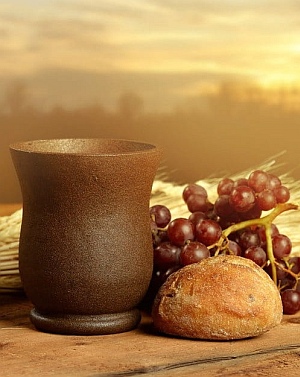
Key Verse: I have eagerly desired to eat this Passover with you before I suffer (Luke 22:15).
Mediation: Christ left the Church the broken loaf of bread and the cup, the Passover symbols that He used in fellowship with the disciples before He went to the cross. The Passover celebrated the deliverance of the Israelis from Egyptian slavery. The Angel of Death had passed over the houses of the Israelis whose doorposts had been smeared with the blood of the sacrificial lamb. The Passover signified physical deliverance from death, but Jesus brought to the entire human race the deliverance from eternal punishment.
Following the Passover deliverance from Egypt, God ratified the Old Covenant made at Mt. Sinai. Regular (yearly) sacrifices had to be made for the people by the priests at the tabernacle or the temple. The New Covenant made by Christ at the communion service does not depend on human beings. While we were yet sinners Christ died for us (Romans5:8). The blood of Christ, a final sacrifice that provides for all those who recognize their Savior and Lord, ratified this New Covenant.
Jesus' eagerness to eat the Passover with His disciples showed His acting out His coming sacrifice and provision for them on the cross. He wanted them all to participate symbolically in the act that He would actually experience. When we participate in the communion service we remember with gratitude Christ’s suffering and provision for us.
Thought for the Day: Since we are saved solely by grace through the sacrifice of Jesus, the sacraments are not our work for salvation but our acts of obedience to the commandments of Jesus.
There is so much more in this simple act that has been repeated in so many churches for over 1000 years. We have forgotten the power of this simple act. We have forgotten the power bestowed to the first disciples through this act. I have decided to include the words of man of God who comes from a Jewish tradition, just as Jesus did.
There are a couple of facts to note in the passages beginning this article. The first fact is that what has come to be known as the "Last Supper" was actually a Jewish Feast. As a Torah observant Jew, Yeshua (Jesus) was celebrating Pesach, the Feast of the Passover. The use of the unleavened bread (Hebrew matzah) and wine did not originate with the Master at the Last Supper. Jews have been celebrating Passover in this manner for thousands of years. Secondly, while Yeshua said the bread IS His Body, He said to divide the wine among them which IS His Blood. Finally, there is only ONE place in scripture where He gives a NEW commandment and that was given here at this Last Passover Seder but only to the disciples - not to the world. Everything else He said and did before this point can be directly referenced back to their origin in the Tenakh (the Original Testament). Yeshua brought nothing new to the table. He showed us how to live what had already been given.
There are only two places where scripture tells us that the Spirit of Elohiem (God) was breathed into men. The first time is in Genesis 2:7 where YHVH breathed into Adam - and, in so doing, imparted Life. The second time is in John 20:19-22 where Yeshua breathed Ruach haKodesh (the Holy Spirit) into the disciples - again, imparting Life. From reading both Leviticus 17:11 and Acts 15:20, we can see that these Hebrews understood that the Life is in the Blood. Communion is a celebration of the Life flowing in and through us.
In Acts 1:8, Yeshua says the Power of that Life becomes resident within us when we receive the gift of Ruach haKodesh (the Holy Spirit). The Greek word used for Power in this verse is dynamis and means inherent power, power residing in a thing by virtue of its nature. It is from this Greek word dynamis are derived the English words dynamic and dynamo. It is the same Greek word we see used in several places of scripture describing the Power flowing from Yeshua's Life that healed and delivered from bondage and was credited to the Virtue, the purity, the excellence of Spirit that dynamo within Him produced (Mark 5:30, Luke 6:19). When we are filled, baptized, empowered with Ruach haKodesh, what we are empowered with is the Virtue of His DNA - His Blood. It begins to course through our veins. This is not a wispy, mystical, ethereal occurrence - it is the Life He said would occur.
So, where is that Power today? If what Yeshua bequeathed to those who would come after Him was the Power to do the Works He did - and greater than the works He did (John 14:12) - then what are we celebrating? Could it be that the words of Yeshua are true? Could it be that the only thing He ever pointed to as having the power to nullify, make void, bring to "none effect" the Power of the Living Word in our lives - the tradition of men (Mark 7:13) - is actually doing what He said it could do because we have ritualized the Power right out of our lives? Where is the Power evidenced in the lives of those early believers, those who were the most recent to witness the Source of that Power? A Power so vibrant, so real that Acts 5:16 describes how all who were sick and possessed of demon spirits were simply brought into the city where these witnesses had accumulated - and they were all healed. The scripture does not say they were brought to an individual - not to Peter, not to John - just into the place where the Body of Believers gathered. What was it about their gathering that was so inherently powerful? Could it be the greater works He spoke of is that, while He was one individual imbued with the Power of the Life, with Ruach haKodesh (Holy Spirit) that Power now resides in many - a greater working of the same Power?
We have lost something. Because of the tradition of men that has been handed down to us, because of the manner, the WAY we approach these words - we have lost something. That something is the Power that accompanied the lives of those written about in the book of the Acts of the disciples. The dynamo, the inherent Power, given to us has ceased to function - why? Could it be we have intellectualized ourselves into impotence? Yeshua always pointed to the works that flowed from Him as a validation of the words He spoke (John 10:36-38) - not the other way around. And, according to scripture, those works came from the Virtue that flowed from Him. He gives us that same Power AS we embrace His manner of Life.
Communion is translated from the Greek word "koinonia" and means fellowship, association, community, joint participation.
According to this definition, the Life does not exist solely in me. Just as much as His Blood flowing in my veins is a mystery unto itself, but nonetheless true - so that same Blood flowing, coursing through the veins of every other believer is just as much of a mystery, but still true. For there is only ONE Body Yeshua inhabits (Ephesians 4:4-6). The bread and the wine He shared at the Last Passover are not just symbols. He said HE is the Bread of Life and that Bread IS His Body (we are His Body) and His Blood (which flows in the veins of His Body) IS the New Covenant spoken of in Jeremiah 31:31-34. He said that as often as we partake of His Body and His Blood, as often as we have a mingling of spiritual intercourse, to do so remembering the example of how He does it with us, as a servant. As often as we partake, have fellowship with one another we should remember His example of considering the things of our brethren as more important than our own (John 13:12-15, Philippians 2:4).
{Sha'ul (the apostle Paul) explains this mystery of the Body in Ephesians 5:30-32. with the example of a marriage relationship. In a marriage between a man and a woman, where we see two distinct, individual entities - in the Father's Eyes, He sees them as one flesh. Yes, one spirit, but, more importantly, ONE FLESH. Reach down and pinch yourself - this is the flesh he is speaking of. In verse 31, he is quoting from Genesis 2:24. The word translated as cleave in this verse comes from the Hebrew devaq and gives the picture of two sticky mudballs smacked together so as to form one inseparable mudball. Sha'ul likens this type of relationship as the same type existing with the Body of Christ. Yeshua is the Head of the Body and we are the members of that Body. It is a mystery but, just as your head does not float around apart from your body, so His Head is not separate from the members of His Body and the members are not separate from either the Head or from each other - even though, looking through natural eyes, it appears otherwise. This is why it only takes two or more for Him, as the Head, to be present at any one time and for His Body to function as a whole. It is a mystery, but true nonetheless.}
Now, if the words of scripture are true and the Life within His Body is the Light of men, then we can visualize a gathering of Believers as the embodiment of the most Brilliant of Light - the Presence of the Father now tabernacled in the hearts of Believers. Since Light and darkness cannot occupy the same space at the same time, when just a small amount of darkness is brought into that Light - there are consequences. When we come together for fellowship, there is a mingling of Life, of this Dynamo that flows between us. We become One Flesh. Just as Yeshua is One in the Father, so we become One in Him - and in each other (John 17:21-23). Yes, one Spirit - but, also, One Flesh.
{Interestingly, the Hebrew word for "glory" used in Exodus 33:18 when Moshe (Moses) asked the Father to "show me your glory", is kavod and has as one of its definitions "liver" which is then applied figuratively as "soul". What is the function of the liver in our bodies? It cleanses the Blood. YHVH then answered Moshe's request and revealed His Glory beginning in the first verses of Exodus 34. The first thing He did was to hand Moshe the Commandments of Virtue written on tablets of stone. His Essence, the Brilliance of His Presence, is then described as He proceeded to pass before Moshe, but a clear definition of His Essence, what that Virtue is, began with the Ten Commandments.}
Virtue is synonymous with Righteousness (see the Law of Righteousness). Virtue is what makes possible the arena of faith whereby the Presence of the Father can only abide in this collective tabernacle not made with hands Hebrews 11:6. Where previously the weakness of the flesh prevented us from maintaining the righteousness necessary to remain in His Presence, now He has given us the means, the wherewithal, the Power to accomplish that righteousness.
We don't comprehend or understand what it means to have the Power of Virtue, the Power of Light resident within us (Romans 8:11). Concentrated into a laser, Light will penetrate any substance.
by a man based in Jerusalem, Israel named
haRold Smith

No comments:
Post a Comment